
How an everyday garment is transitioning from supporting the body to influencing the way we perceive, measure, and understand it: the bra.
By Ehab Soltan
HoyLunes — There is a health variable you use every day and that almost no one measures. It is a moment that nearly all women recognize, but few stop to analyze. You arrive home, close the door, and, almost without thinking, perform a physical gesture that generates immediate and deep relief: you take off your bra.
For years, we have interpreted this clear sensation as a simple search for comfort at the end of the day. However, that explanation falls short given the intensity of the relief. If removing a garment triggers such a clear sensory response, the truly important question is not how the body feels *without* it, but what physiological and sensory processes are occurring, minute by minute, while you wear it for hours.
We must begin by understanding that the bra is not a passive element of fabric; it functions as a real interface based on mechanotransduction that constantly interacts with our biology. It is an uninterrupted source of mechanical pressure on the tissue, a thermal signal on the skin, and a sensory stimulus that the central nervous system processes unceasingly.
It is fundamental to clarify, to avoid sensationalism, that science has not proven that wearing a bra causes serious diseases. Claiming otherwise would lack rigor. But research has indeed begun to observe something more subtle and relevant to daily well-being: this garment has the capacity to modulate the body’s physiological behavior throughout the day.
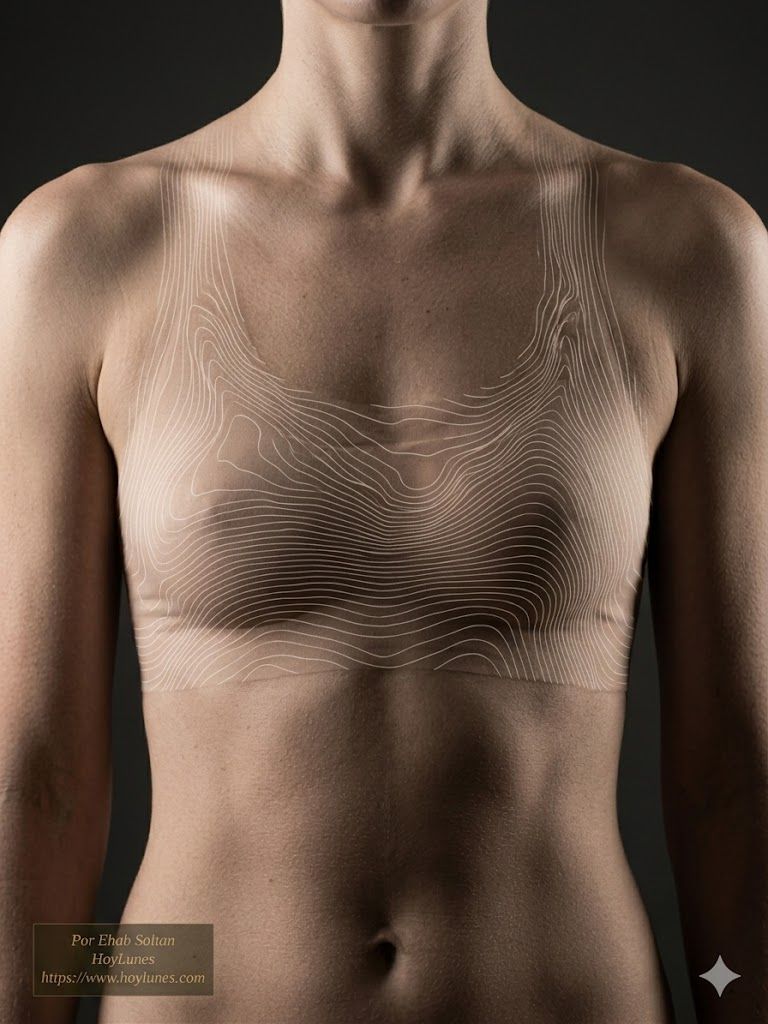
Studies documented in biomechanics, such as those conducted by the University of Portsmouth, confirm that appropriate support significantly reduces breast tissue movement and associated pain, especially during physical activity. This is a clear and measured benefit. However, reducing movement is not an isolated event; it changes the dynamic relationship between the body and its immediate environment, forcing the organism to make constant microadjustments. The problem is not the support. It is not understanding what changes when you maintain it constant.
Every time a garment exerts constant and localized pressure on the torso, the body responds adaptively. It does not do so with an alarm symptom, but with subtle and continuous adjustments: small variations in posture to compensate for the tension, slight changes in the thoracic breathing pattern, and a redistribution of muscle tensions in the back and shoulders. Added to this is sensory habituation: the nervous system gets used to the pressure signal and you stop “noticing” it consciously.
This modification mechanism is not pathological in itself, but a demonstration of our biological plasticity. Nevertheless, it invites us to reflect on how many biological decisions and microadjustments we are conditioning daily, passively, through what we choose to wear.
There is another crucial biological factor that is often overlooked in conventional design and general conversation: the skin microclimate. The space trapped between the skin and the bra fabric creates its own environment that tends to be warmer, retains more moisture due to perspiration, and has less natural ventilation. This constant alteration of the local microclimate influences aspects that medical science already studies, such as skin microbiota and long-term skin sensitivity. We are not talking about disease, but daily biological context. And context, when repeated for 12 hours a day, year after year, matters in the equation of accumulated health.
This is where the scientific conversation becomes deeper and more fascinating, passing from physical support to body perception. The organism not only reacts physically to the pressure; it also interprets it centrally. The constant signal on the torso can silently influence interoception, which is how your body perceives its own state without you realizing it: how you subconsciously register your respiratory rhythm, how you modulate your habitual movements, or how the brain processes tension or relaxation in that area.
This field of neuroscience is gaining relevance because it connects body perception directly with states of fatigue and general well-being. The hypothesis is eloquent: it is not just what the bra does to the body, it is what the central nervous system stops registering while the pressure signal is active.
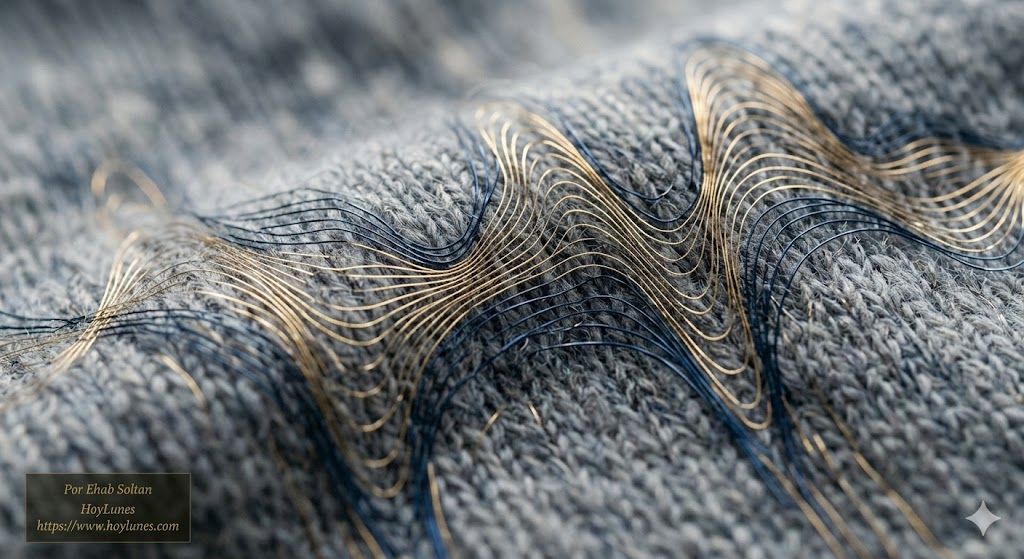
While this biological understanding is just beginning to permeate general awareness, the innovation market has already detected a strategic opportunity for the 2026 horizon. And this is where biology converts into business. The bra is undergoing a metamorphosis, ceasing to be a passive support garment to become an active digital health platform.
Pioneering companies in textile technology are developing smart textiles capable of measuring physiological parameters with medical precision, such as heart rate and its variability, detailed respiratory patterns, localized body temperature, and physical activity levels. All this integrated organically, without visible devices or additional watches, directly on the skin.
What we are witnessing is the birth of an entirely new technological category: integrated “biowear”. We are facing the possibility of garments that not only adapt to anatomy, but interpret physiology in real time, dynamically adjusting their compression based on activity, adapting to hormonal volumetric changes, or responding to real body temperature. This aligns with a macro trend in health: moving from pure aesthetics to passive and personalized physiological regulation. The difference will not be measuring more data, but deciding which data matters for the real body, not for the dashboard.
This paradigm shift forces a revision of the current value proposition. Today, the vast majority of brands continue to center their message on traditional concepts such as aesthetic shape or mechanical support. But they are ignoring the question that truly matters for the user’s long-term health and loyalty: how does that body feel and behave physiologically after 10 hours of continuous use?
Therein lies the true opportunity. The next competitive and strategic advantage will not come from visible design, but from the garment’s ability to reduce accumulated load on the musculoskeletal system, facilitate optimal breathing patterns, and improve local metabolic comfort efficiency.

Ultimately, we must begin to observe the everyday as a strategic health variable. It is not always necessary to make drastic lifestyle changes to positively influence personal biology; often, the key lies in optimizing what we mechanically repeat every day. A bra does not determine a woman’s state of health, but the continuous interaction with that garment for 12 hours daily, for decades, is indeed part of the biological system. Understanding this completely changes the approach: we are no longer talking about fashion or superficial comfort, we are talking about accumulated physiological behavior.
The next time you arrive home, take off your bra, and feel that characteristic wave of relief, do not dismiss it as a simple comfort routine. Ask yourself with scientific curiosity what part of that relief belongs to the body’s natural release and what part belongs to the cessation of constant adaptation to an external signal. Because in that difference, almost imperceptible but profoundly real, lies one of the most relevant and necessary conversations about female health of this decade.
Innovation in health does not always arrive in the form of a new drug. Sometimes it arrives transforming something you already use every day, but that no one had taught you to observe with biological rigor. The bra is beginning to become a smart interface between the body and well-being. Brands that understand this will not design bras. They will design how a body feels after living within them.
Sources and Scientific Reference Lines
This analysis is supported by established lines of research in biomechanics and physiology:
University of Portsmouth — Pioneering studies on breast biomechanics and support.
Journal of Biomechanics — Research on breast tissue movement and external support.
Skin Research and Technology — Studies on skin microclimate and local microbiota.
Frontiers in Neuroscience — Advances in interoception and central body perception.
#WomensHealth #Biomechanics #Wearables #Longevity #RealWellbeing #HoyLunes #HealthInnovation #EhabSoltan #HealthTech #Biowear #Physiology #Neuroscience #Interoception